Week 1: The Composer’s Voice - From Schubert to Strauss
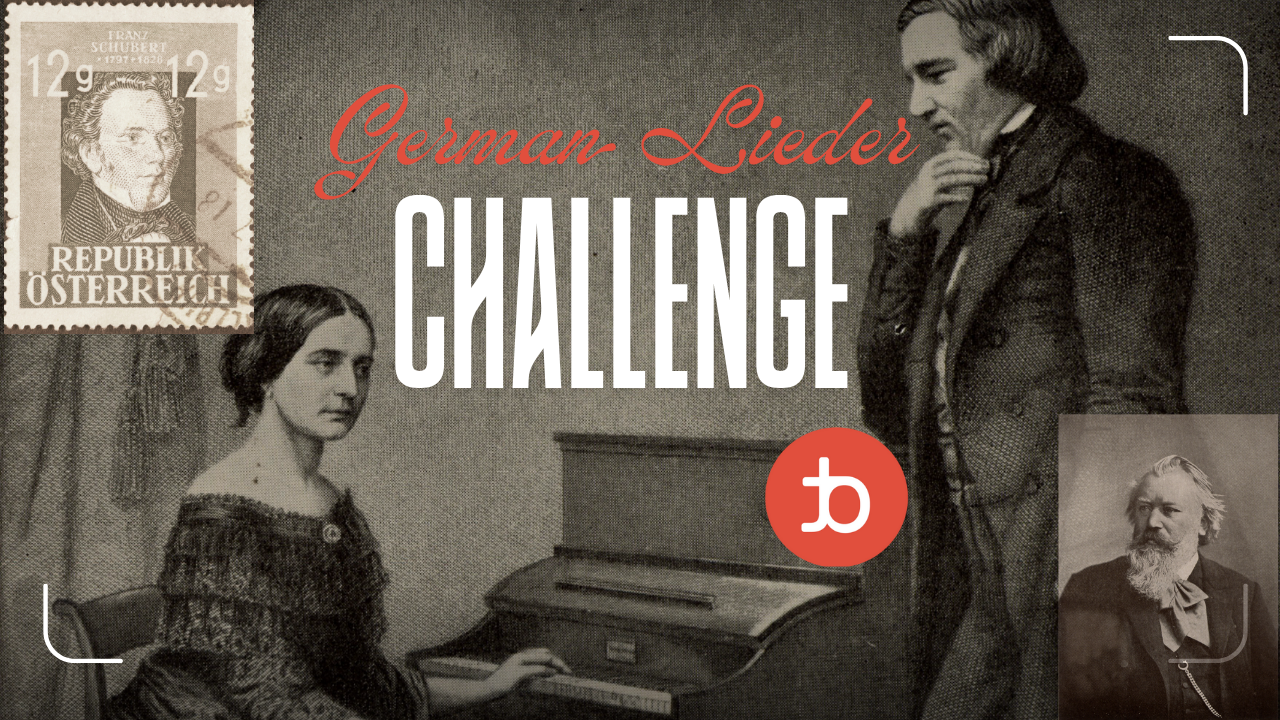
Welcome to the Discovery Challenge: German Lieder
Welcome to the Discovery Challenge: German Lieder — a two-week exploration of one of Western music’s most intimate and intellectually rich art forms. Together, we’ll uncover how composers from Schubert to Strauss shaped poetry through melody, harmony, and prosody — and how singers bring that knowledge to life in sound. Each day, you’ll listen, analyze, and discuss the musical elements that define the Lied tradition: phrasing, harmonic pacing, text setting, and expressive rhythm. In the second week, you’ll translate that insight into practice — studying, singing, and recording your own excerpt. This challenge is both scholarship and art: a chance to deepen your musical literacy, refine interpretive awareness, and experience how understanding transforms expression.
DAY 1 — Franz Schubert (1797 – 1828)
TL;DR: Austrian composer whose nearly 600 songs defined the modern Lied through melodic invention, text sensitivity, and harmonic depth. His music bridges Classical clarity and early Romantic expressivity. (Grove Music Online, “Schubert.”)
Schubert established the foundation of the nineteenth-century Lied through a synthesis of melodic invention and poetic structure. His songs demonstrate clear tonal organization, alignment between phrase rhythm and text rhythm, and accompaniment textures — often ostinato or arpeggiated — that define atmosphere and motion (Song: A Guide to Art Song Style and Literature, pp. 45–63; Youens, Grove).
🎧 Task: Post a recording that demonstrates Schubert’s coordination of melody, harmony, and poetic form.
💬 Discuss: How do harmonic rhythm and accompanimental design articulate the poem’s structure?
DAY 2 — Robert Schumann (1810 – 1856)
TL;DR: German composer and critic central to early Romanticism, renowned for piano cycles and songs that combine poetic imagination with structural cohesion. (Grove Music Online, “Youens – Schumann.”)
Schumann expanded the Lied into a cyclical and narrative art form, integrating motive, rhythm, and harmony to express the poem’s psychological development. His songs show acute attention to speech rhythm, the use of piano pre- and postludes as commentary, and motivic links that unify cycles such as Dichterliebe and Frauenliebe und Leben (Song, pp. 129–145; Youens, Grove).
🎧 Task: Add a recording from one of Schumann’s cycles demonstrating structural unity.
💬 Discuss: Which musical elements — motivic recall, harmonic pacing, or dynamic contour — govern the continuity of the setting?
DAY 3 — Johannes Brahms (1833 – 1897)
TL;DR: German composer who fused Classical discipline with Romantic lyricism; his contrapuntal mastery and rhythmic subtlety shaped late-nineteenth-century musical language. (Grove Music Online, “Brahms.”)
Brahms’s Lieder combine Classical balance with Romantic expressivity. Long-spanned melodies and deliberate harmonic rhythm create architectural proportion, while motivic development ensures coherence. His preference for strophic or modified-strophic form, rich inner-voice writing, and restrained text painting reflect structural discipline rather than overt gesture (Song, pp. 185–198; Bozarth & Frisch, Grove).
🎧 Task: Share a performance that reveals Brahms’s formal clarity.
💬 Discuss: How do phrase length, harmonic rhythm, and motivic repetition generate continuity?
DAY 4 — Hugo Wolf (1860 – 1903)
TL;DR: Austrian composer who brought the Lied to peak textual precision through chromatic harmony and speech-like declamation; often viewed as Wagner’s heir in miniature form. (Grove Music Online, “Wolf.”)
Wolf composed with the poem as his structural framework. Each song mirrors linguistic inflection through flexible rhythm, chromatic harmony, and concise motivic design. His integration of piano and voice as equal partners and use of harmony for semantic emphasis define his mature style (Song, pp. 225–236; Youens, Grove).
🎧 Task: Post a Wolf recording illustrating alignment of text stress and musical accent.
💬 Discuss: Which aspects of rhythm, articulation, or harmonic color best support textual meaning?
DAY 5 — Richard Strauss (1864 – 1949)
TL;DR: German composer and conductor who extended late Romantic tonality to symphonic scale; his Lieder are notable for opulent harmony and vocal brilliance. (Grove Music Online, “Youens – Strauss.”)
Strauss extended Lied composition into the late-Romantic harmonic and dynamic spectrum. Expansive melodic lines, wide registral range, and dense, orchestral piano textures require clarity of diction and resonance control. His settings favor long-arched phrasing in which harmonic motion and dynamic architecture carry expression rather than local word painting (Song, pp. 254–263; Youens, Grove).
🎧 Task: Add a Strauss recording balancing vocal clarity and rich accompaniment.
💬 Discuss: How do harmonic pacing and dynamic design maintain coherence across large phrases?
DAY 6 — Clara Schumann (1819 – 1896) & Fanny Mendelssohn (1805 – 1847)
TL;DR: Clara Schumann was a German pianist-composer whose songs exemplify elegance and structural control; Fanny Mendelssohn, sister of Felix, wrote refined, expressive Lieder marked by harmonic imagination and fluid melody. (Grove Music Online, “Schumann [Wieck], Clara”; “Mendelssohn [Hensel], Fanny.”)
Both composers contributed refined, text-sensitive works within the early Romantic idiom. Clara’s songs display symmetrical phrasing, clear prosody, and economical harmony; Fanny’s favor continuous melodic flow and subtle chromatic shifts supporting imagery. Their writing values intimacy and formal clarity over virtuosity (Song, pp. 154–160 [Clara]; 116–118 [Fanny]; Citron, Grove).
🎧 Task: Choose a Lied by either composer that demonstrates refined craftsmanship.
💬 Discuss: How do harmonic color and phrase proportion shape expression without overt display?
DAY 7 — Post-Romantic and Modern Continuities
TL;DR: The Lied tradition persisted through composers such as Mahler, Zemlinsky, Alma Mahler, and Berg, who reinterpreted text-music relations within expanded tonality and modernist idioms. (Grove Music Online, “Mahler”; “Berg.”)
These later composers redefined Lied through broadened harmonic language and speech-like rhythm while maintaining focus on text and melodic line. Motivic integration and expressive prosody continue as central organizing principles amid innovation (Song, pp. 283–296; Grove).
🎧 Task: Add one twentieth- or twenty-first-century Lied to the playlist.
💬 Discuss: Which elements of harmony, rhythm, or motivic structure preserve the Lied tradition within new idioms?
References
Carol Kimball, Song: A Guide to Art Song Style and Literature. Milwaukee: Hal Leonard, 2013.
Grove Music Online. Oxford University Press — entries by Susan Youens, Marcia Citron, George Bozarth & Walter Frisch.
7 replies
-
Hi Heidi, sorry I was wrong, I believed the Office Hours were today... So I put a question for you there...
I will begin to send some things tomorrow for day 1 and 2
-
Day 1
Hi Heidi,
Here is my personnal reflection on This Lied of Schubert :
(180) Schubert: Auf dem Wasser zu singen, D. 774 - YouTube
Auf dem Wasser zu singen
I feel this melody as a kind of meditation on water.
The narrator is in a boat at sunset. The water is calm and nature is beautiful. A sense of joy emanates from this beauty. One can imagine the light changing as time passes, at the end of the day as the sun goes down.
The passing of time is one of the themes of this Lied. Immersed in nature and in the present moment, the narrator reflects on time passing, along with his own life — a life that, too, will one day have its own sunset.
There is a spiritual dimension in feeling this joy and this ever-changing present — a kind of consolation in the face of the anxiety of our fleeting passage on earth.
The poem is imbued with melancholy, gentleness, and inner questioning.
The poem has three stanzas ; the music is also strophic.
Each stanza begins in a minor key. The last phrase of each stanza is then repeated in a major key, as if offering consolation or peace.
The Lied begins with a pianistic introduction in a minor key, setting the scene and atmosphere — both external and intimate. It ends with a solo piano coda in the major key, bringing light to the conclusion of the Lied.
The Lied is written in 6/8 time, the triple meter evoking the rocking of the boat.
The right hand of the piano plays flowing sixteenth notes, like the passing of time and the shimmering reflections on the water.
Each line of the poem is set to two bars of singing, creating a kind of regularity that invites calm. The right-hand melody of the piano is also regular, built on a melodic pattern per measure. This pattern, beginning with an ascending octave followed by a descending phrase, reminds me of the movement of the oars — the octave symbolizing the moment when the oar enters the water through the rower’s effort. But it could also represent the cyclical repetition of passing time.
-
It took me a long time to work on this analysis. No time today for another one !